
Erie Previous Residents: Era Sources
Previous residents of an Erie address leave different traces in different decades. Begin with the parcel and county, then select a source whose time span fits the question. A current assessor result can orient the address. A recorder index can identify parties to a conveyance. A directory or census can show a household. A map, permit, cemetery file, or newspaper can explain what happened between two dated entries.
| Source | Years or Cutoff | Where Held | What It Shows |
|---|---|---|---|
| Boulder recorded-document index | County records date to 1860 | Boulder Recording / Public Search | Grantor, grantee, instrument, date, legal description, image options |
| Weld EagleWeb | January 1, 1865 onward | Weld Clerk and Recorder | Catalog-style party, reception, document, subdivision, and related-search clues |
| Weld historical parcel cards | Not updated since 2002 | Weld Assessor historical cards | Older parcel values and characteristics, not current ownership |
| Town GIS and eTRAKiT | Current public systems; start by record type not published | Town of Erie | Parcel, address, permit, project, inspection, license, and violation clues |
| Directories and newspapers | 1902 telephone directory; 1884-1893 surviving Erie-Canfield issues | Carnegie, DPL, local newspaper collections | Names, phones, notices, social ties, moves, and local events |
| Federal census | 1790-1950 currently public | Census and archive services | Household composition, ages, birthplace, occupation, and enumeration context |
| Sanborn map | November 1900 | Library of Congress | Building footprint, street context, use, and fire-insurance details |
| Mount Pleasant Cemetery | Headstones from 1869; deeds from 1901; interment files incomplete | Town Cemetery | Burial names, dates, plot clues, stones, deeds, and record gaps |
The table is an access plan, not a promise of a complete household list. Online indexes are the fast start. The recorder counter, phone, email, mail, and drop-box routes matter when an image or older book is not online. Libraries, archives, and historical collections supply the social layer. A careful trail records which channel was used and what that channel actually proves.
Erie Address History: Parcel Start
Begin with the Town of Erie parcel layer or the county assessor that owns the parcel. The Town layer separates the property side from the owner mailing side. Useful fields include parcel, NAME, CAREOF, ADDRESS1, ADDRESS2, ZIPCODE, street components, FULL_ADDRE, LOCCITY, subdivision, lot, block, and LEGAL. Preserve the result exactly, along with the date inspected.
| Key to Save | Why It Matters for Past Residents |
|---|---|
| Parcel or account | Stable county or Town identifier for joining later records about previous residents. |
| Situs address | Current property location, which may differ from historic street wording. |
| Owner mailing address | Tax-notice destination, not proof that the owner lived at the parcel. |
| Subdivision, lot, and block | Useful when an old street number or postal city no longer matches. |
| Legal description | Recorded land identity that bridges address changes and deed searches. |
Use the Boulder County Property Search for the Boulder-side parcel and the Weld County Property Portal for the Weld-side parcel. The Town crosses the county line, so “Erie” is not enough to choose a recorder. A mailing address may point to another city, a care-of line, or several parcels. Treat it as a lead for the deed trail, not a household answer.
Erie Past Residents: Deed Trail
The recorder's index is the strongest way to move backward through property ownership and trace previous residents through records. Use the Boulder County Public Search for the Boulder side and Weld EagleWeb for the Weld side. Boulder reports county records dating to 1860 and free watermarked images in its newer search platform. Weld states that recorded instruments begin January 1, 1865, and describes EagleWeb as an index like a library card catalog rather than the deed itself.
- Save the current owner, parcel or account, legal description, subdivision, lot, block, and inspection date from the assessor or Town layer.
- Search the current owner as grantee, then narrow by legal description, subdivision, document type, and date. Record the reception or document number.
- Read the purchase instrument for its grantor, grantee, recording date, consideration if shown, and every legal-description variant.
- Search the seller as a prior grantee. Continue backward until the index reaches an earlier description, original subdivision plat, developer instrument, or the online horizon.
- When the online trail stops, ask the recorder about counter terminals, deed books, microfilm, office copies, mail, email, or drop-box service. The exact early-image cutoff depends on the instrument and county.
- Grantor and grantee
- The grantor transfers an interest. The grantee receives it. Searching both roles prevents a deed chain from stopping at the first seller.
- Chain of title
- The linked sequence of recorded transfers that connects a later owner to earlier parties and legal descriptions.
- Legal description
- Recorded land language such as subdivision, lot, block, tract, or survey information. It can outlast a changed street number.
The Boulder Property Alert is a separate name-based alert for recorded documents. It can help monitor a name or trust, but the county warns that common names can create false matches. It is an alert service, not a substitute for reading the deed and matching the parcel.
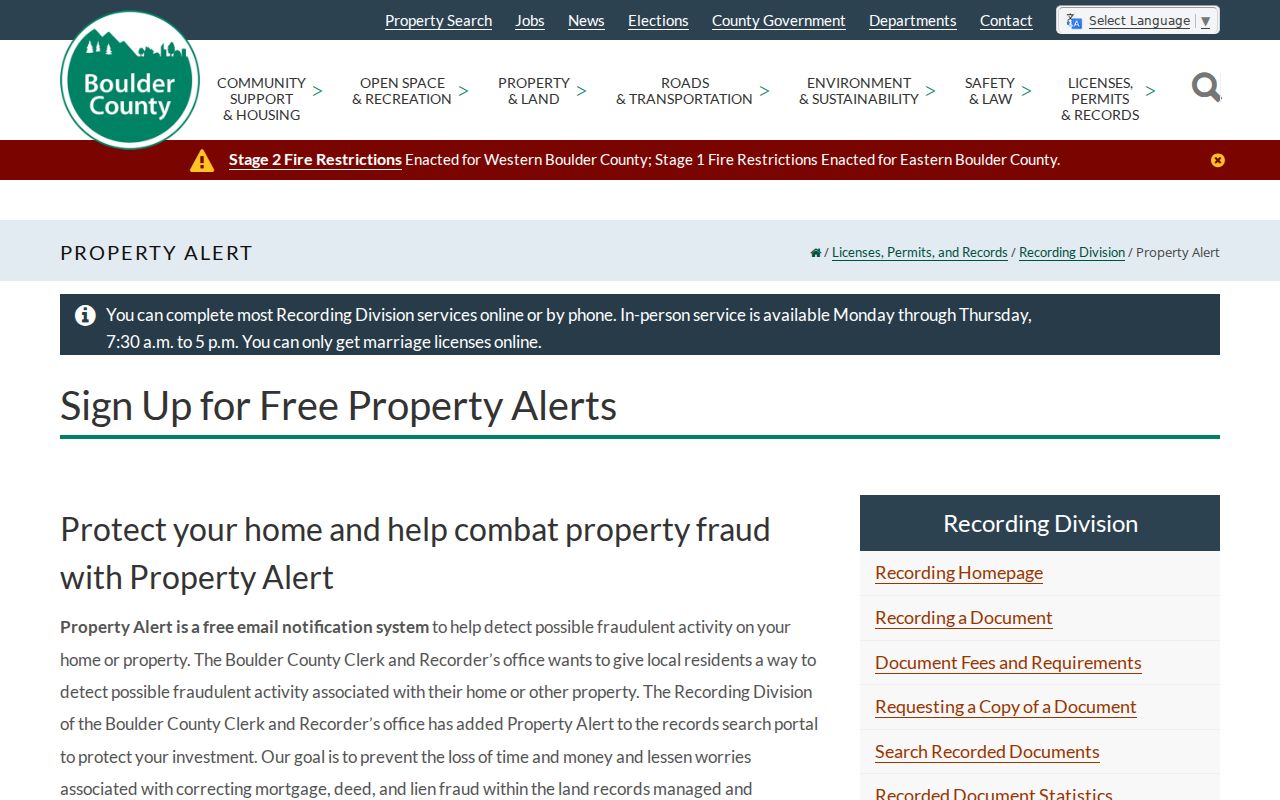
The alert image belongs beside the deed workflow because a notice can flag a recording while the parcel, legal description, and instrument still supply the proof needed for a house history.
Boulder Recording Division
1750 33rd St., Suite 201, Boulder. Monday through Thursday, 7:30 to 5. Phone 303-413-7770; recording@bouldercounty.gov. Office, drop-box, mail, and email routes are documented.
Weld Recording Department
1250 H St., Greeley. Phone 970-304-6530; crstaff@weld.gov. Use the office when index access, images, or the early record range needs confirmation.
Erie House-History Help
Carnegie Library's house and building research guide supplies the best verified house-history support for an Erie address. It points to genealogy resources, reference staff, Boulder Genealogical Society material, simple lookups, and scanning requests. The Carnegie local-history service is at 1125 Pine St., Boulder, phone 303-441-3110, askcarnegie@boulderlibrary.org, with walk-in hours Thursday and Saturday from noon to 5 and appointments for deeper work.
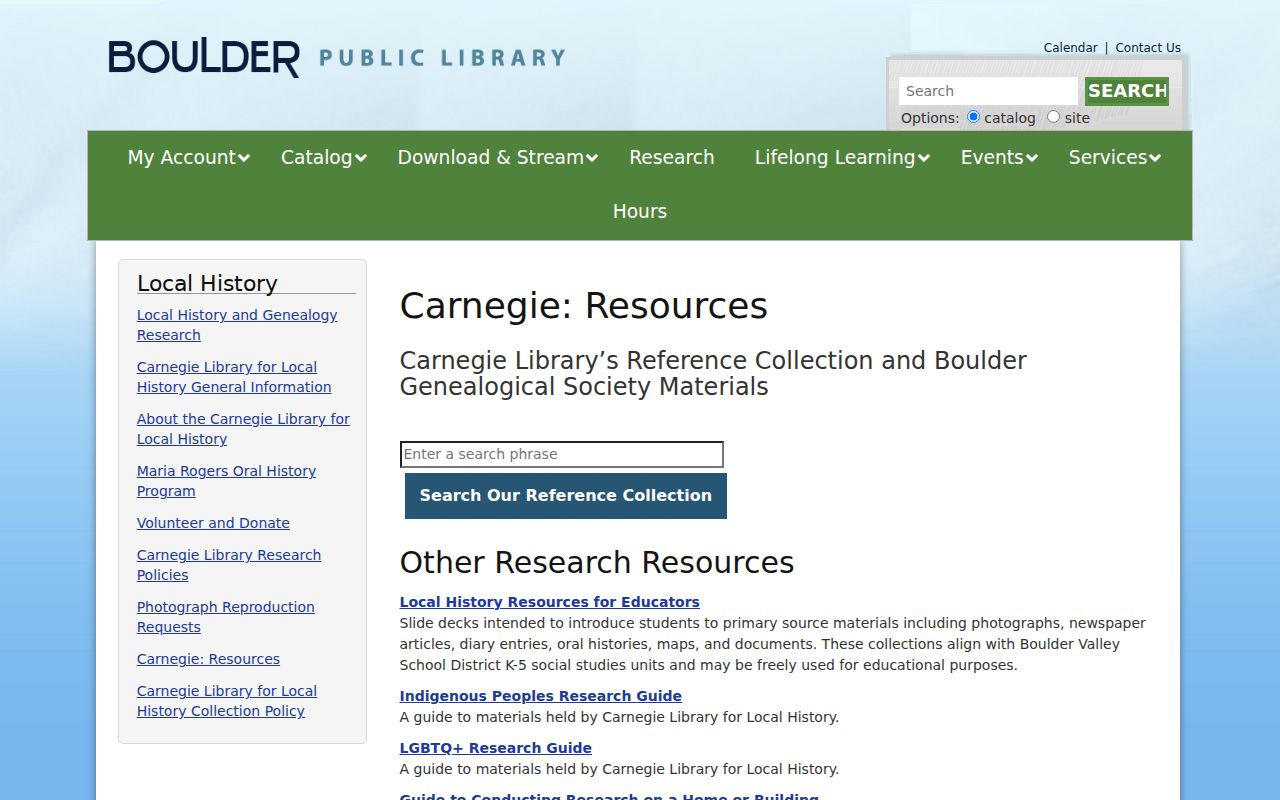
The guide's value is practical. It helps connect a parcel to photographs, directories, newspapers, manuscripts, and a local address story without claiming that every Erie volume is digitized.
The Erie Community Library, a High Plains Library District branch opened January 12, 2008, offers nearly 60,000 items, Wi-Fi, courier service, meeting space, and online databases. Genealogy resources moved through the system's LINC material, but the branch page does not publish a complete run of printed Erie directories, obituary indexes, or yearbooks. Ask staff about the current shelf and database route rather than assuming a title is held.
The local newspaper run list gives a second access channel. Its title changes and surviving-issue notes help target a year before requesting a scan, visiting a collection, or searching the Colorado Historic Newspapers portal.
Erie Past Residents: Directory Pairing
Directories supply the household layer that a deed cannot. Erie often appears in regional books rather than a stable town-only phonebook. The Denver Public Library Colorado Directories Index advises searching for *Erie and checking Longmont, Boulder, and Denver books. Carnegie's verified 1902 Telephone Subscribers Directory includes Erie among Boulder-area communities. Its catalog lists names and phone numbers, but the scanned page and abbreviation key were not exposed in the inspected text.
Newspapers widen the same trail. Carnegie holds 17 surviving Erie-Canfield Independent issues from 1884 through 1893, not a complete run. The local run list carries title changes from Erie-Canfield Independent through Erie Echo. Search a surname, street, mine, school, church, marriage, sale, or death notice, then compare the date with the deed and census rather than treating one notice as a complete address record.
- Search the DPL index for the original municipality label, then repeat with Longmont, Boulder, Denver, and the county name.
- Record the exact year, title, page, address, initials, spouse or widow notation, and call number. Keep spelling variants beside the original form.
- Pair 1902 directory evidence with the 1910 Census, and pair later directory years with the nearest public federal schedules through 1950. Census boundaries may use township or precinct names rather than the modern Town.
- Join the household clue to a deed, permit, newspaper notice, cemetery record, or probate entry. A directory contact is contemporaneous evidence, not proof of current residence.
The historical collection itself has a fuller treatment in the Erie city directory material. The backward address trail should borrow the relevant year and entry, then return to the parcel and deed keys.
Erie Sanborn Sheet, November 1900
The Library of Congress Erie Sanborn item is a verified one-sheet map dated November 1900. It shows the built environment, street names, building footprints, uses, and fire-insurance context. It does not serve as a complete list of people who lived in each building.
Use the sheet when tracing previous residents at a stubborn address. A map can show whether a structure and street existed in the 1900 setting, while a directory supplies a name or phone, a census supplies household context, and a deed supplies the land chain. Additional Erie Sanborn years were not verified in the research record, so the November 1900 sheet should not be expanded into an unverified map series.
Note: A Sanborn building footprint can support address continuity, but it cannot turn a property image into an occupant list.
Erie Past Residents: Permit Clues
Permits can date a building, alteration, or change of use without naming every person who lived there. Erie eTRAKiT has public modules for permits, projects, contractors, properties, inspections, licensing, violations, and map or address location. A permit result may show an applicant, owner, contractor, project address, permit type or status, inspection event, and public attachment. An applicant is not automatically the owner or a resident.
For older or restricted material, use the Town's building-record request route. The request categories include plot plans, improvement location certificates, permit cards, Certificates of Occupancy, soils reports, receipts, and foundation, structural, or engineered records. The Town says requests are usually handled within three business days, sometimes seven working days, and some documents are view-only because of copyright. Fees can reflect staff time, copies, or map production. The Town Clerk routes the request, and the records hub provides the general request path.
Boulder County land-use records can add permits, planning, septic, code-enforcement, and special-event records for the Boulder side. Their date depth varies by dataset. For a precise request, identify the parcel, address, record class, and date range. The Town's July 2026 permit-payment warning also matters: verify payment through the official Town permit portal, Town Hall, or the Town phone rather than trusting an invoice email.
Erie Addresses Through Time
Erie's 1871 plat and 1874 incorporation sit behind a street system that later gained subdivisions, annexations, and new address points. Town addressing guidance says preliminary plats establish street names while final plats and site plans establish addresses. The official material inspected did not verify a Town-wide street-renumbering or renaming event and year.
When a number fails, retain the old label and search the street, neighboring street, subdivision, owner surname, legal description, Sanborn sheet, and current parcel geometry. Search Kattell and Kattel both ways. Briggs, Holbrook, Pierce, Moffat, and Cheesman are historic Erie street names that can connect a person or place clue to the Town history and local architectural surveys. Do not silently convert an old “Erie, Weld County” label into a current ZIP or Town boundary.
Erie Past Residents: Death and Heirs
Death, cemetery, obituary, and probate records can close a household chapter after a deed or directory trail ends. Mount Pleasant Cemetery's history says the oldest headstone is 1869, first deeds refer to “Erie Cemetery” in 1901, and the grounds include roughly 1,300 burials with more than 300 unmarked graves. Almost no pre-1901 interment records survive apart from intact stones. About 200 burial transit permits exist, more than 100 without a burial location, and the electronic cemetery system dates from 2009. Interment records are incomplete before the 1960s.
Use the Town's cemetery search and manager route, then compare stones, deeds, transit permits, newspaper notices, and probate. The Colorado vital system is different. C.R.S. §25-2-117 makes current vital statistics confidential and requires a direct and tangible interest for certified copies. The Colorado State Archives search makes birth records available for research at 100 years, while official death instructions state death records become public after 75 years. Statewide birth registration began in 1908, so older research may move to county books, church records, newspapers, stones, and archives.
Probate and divorce files belong to district courts, not a single Erie clerk. Use the Colorado court document request route or the local clerk when a docket points to an estate. A probate file may identify an executor, heir, inventory, or later conveyance, but access and redaction rules apply. No standalone Erie or Weld probate name-search portal was verified in the research material.
Erie Past Residents: Gaps and Safe Use
A gap in an Erie previous residents trail can be meaningful. It may mark the 1860 Boulder or 1865 Weld index horizon, the 2002 cutoff on Weld historical parcel cards, an incomplete newspaper run, the Mount Pleasant pre-1901 record loss, a changed address, or a protected record. Mark the gap and the next custodian to ask. Do not fill it with a same-name guess.
Colorado's Address Confidentiality Program can place an eligible survivor's mail behind a substitute address, and protected voter records may not appear in a public lookup. Keep only the source URL, date, county, document or account number, and narrow historical clue needed for the house-history question. Do not publish a full birth date, protected address, medical detail, unredacted court image, or raw vital record.
Lawful house history. Previous-resident research is appropriate for genealogy, family history, preservation, and a documented history of a property. Colorado stalking and harassment laws, including C.R.S. §18-3-602 and C.R.S. §18-9-111, do not permit repeated unwanted contact, intimidation, or tracking of a living person.
Note: A dated source trail is stronger than a broad name search because it keeps ownership, household presence, and historical context separate.