
How Erie Residents Are Found
The practical Erie residents directory is a chain of public sources. The Town parcel layer can place an address and show a legal owner or mailing line. A Boulder or Weld assessor can add account, value, sales, building, and legal-description clues. The recorder index shows parties to a deed, lien, plat, or related filing. A voter lookup checks one known person with a first name, last name, ZIP, and birthday. None of those records is a complete list of the people in a home.
Start with the narrowest fact. A known street calls for a parcel search. A full name calls for a county check plus the Colorado lookup. A family-history question may belong in newspapers, directories, census schedules, cemetery records, or the State Archives. Erie crosses the Boulder-Weld county line, so the Town name alone cannot choose the right office.
- Place the address or name in the Town GIS and identify the county, parcel, subdivision, and legal description.
- Search the matching Boulder or Weld property portal, saving the owner and mailing fields separately from the situs address.
- Use the Colorado voter lookup for a known person, and treat a protected or missing match as an access result, not proof of absence.
- Search the recorder by grantor, grantee, document type, date, and legal description to connect a person with a recorded transaction.
- Move to the library, newspaper, cemetery, court, or records-request route when the public index ends.
That order keeps the Erie residents directory grounded. Ownership, registration, a court party, a business affiliation, and occupancy are different facts. Record the source date and the exact field that produced each clue.
Note: A county-line address can require a Boulder search and a Weld search before the record trail is complete.
Erie Resident Records Offices
Four office paths matter most at the start of an Erie residents directory search. Boulder County and Weld County each maintain recording and assessor systems. The Colorado Secretary of State provides the public voter match, while county election offices control local data requests. The Town of Erie remains the custodian for municipal court requests, police records, permits, licenses, cemetery files, and many local map layers.
Use the online index when it fits, then use the office counter, phone, email, mail, or a focused request. The recorder indexes are not interchangeable. Boulder County says its recording history reaches back to 1860; Weld's EagleWeb states that recorded instruments begin January 1, 1865.
County Assessors
Boulder: 1325 Pearl St.
Weld: 1400 N. 17th Ave.
303-441-3530 / 970-400-3650
Colorado Elections
State match and voter-data route
Denver, CO
303-894-2200
Erie County Lines Shape Resident Searches
Erie is a municipal place with a split county record map. A parcel on one side of the Town may route to Boulder County, while another parcel routes to Weld County. The Town GIS exposes a local city label, legal description, subdivision, account or parcel key, and annexation or tax-district context. Those fields help choose the recorder and assessor. A postal last line such as Lafayette or Longmont is not a safe substitute for the county named in the legal description.
The same split affects courts, elections, property taxes, sheriff records, and vital-record requests. A known Erie person may have a Boulder voter record, a Weld deed, or a municipal court file held by the Town. Check the county before deciding that a no-match means the person or parcel is absent. The Erie residents directory is more accurate when jurisdiction is treated as a question to solve.
Note: Keep the Town label, postal city, county, ZIP, and legal description as separate fields in research notes.
Start With Erie’s Resident Parcel Records
The Town of Erie OpenData service is the best first map when an address is known. Its layer list includes Address Points, Centerlines, Subdivisions, Parcels, the Erie Address Grid, Town Boundary, annexations and tax districts, voting precincts, schools, zoning, and planning layers. Click the address point, then inspect the parcel polygon. The point locates an address; the parcel carries the legal and tax geometry.
The parcel layer exposes `Parcel`, `NAME`, `CAREOF`, `ADDRESS1`, `ADDRESS2`, `CITY`, `STATE`, `ZIPCODE`, `FULL_ADDRE`, `LOCCITY`, `LOT`, `BLOCK`, `LEGAL`, `SUBNAME`, and other fields. Query, Identify, Export, GeoJSON, distance, and selection tools are available. The service states a 20,000-record maximum and a 2,000-selection limit, so a street or map-area filter should come before an export.
The screenshot below comes from the official Erie GIS layer inventory and shows the kind of map context that helps route an address.
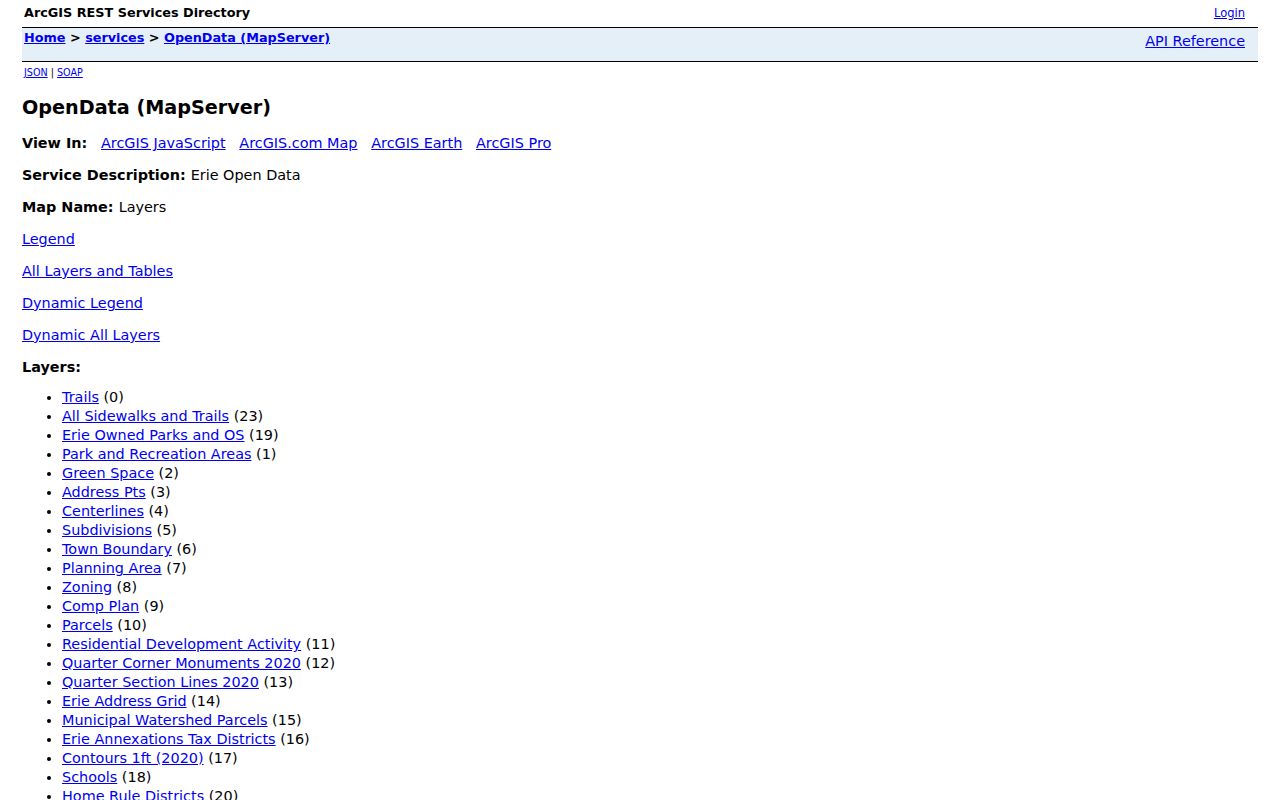
Use the map for geography, not as a complete household roster. Save the parcel key, county clue, legal description, and inspection date before moving to the assessor or recorder.
Check an Erie Voter Lookup Carefully
The Colorado Find My Voter Registration tool is a match service for one known person. It asks for four fields. The ZIP is tied to the registration and the page advises trying a prior ZIP after a move. A match can help confirm registration status and an election district. It does not create a public street roster or establish that every person at an address is registered there.
Boulder County publishes monthly SCORE data and request instructions, while Weld County Clerk and Recorder serves as the local elections custodian for Weld-side records. Formal data requests can include residence and mailing fields, precincts, districts, and participation fields, but protected, confidential, and preregistered electors are excluded or withheld. Ballot choices are secret.
| Lookup field | What to enter | Why it matters |
|---|---|---|
| First name | Name as registered | Preserve the spelling used by the record |
| Last name | Last name, or the name field for a one-name person | Try known spelling variants in a separate check |
| ZIP | Registration ZIP | Try the prior ZIP after a documented move |
| Birthday | MM/DD/YYYY | Helps separate same-name registrations |
Absence can result from a protected address, a county-line mistake, a spelling difference, an inactive record, or a recent move. The result is one piece of the Erie residents directory, not a final identity decision.
Current Erie Directory Sources
Present-day directory work is a matter of matching a record to the question. A parcel roll is strongest for recorded ownership. The voter tool is for a known registration. A deed index shows transaction parties. A Town business directory or cemetery search supplies a public affiliation or burial clue. The sources below are useful because their limits are visible.
| Source | What it can show | Keeper | Access |
|---|---|---|---|
| Town parcel layer | Owner name, mailing and situs clues, legal and subdivision fields | Town of Erie GIS | Public map and query |
| Property portals | Owner, account, parcel, address, values, sales, or tax clues | Boulder and Weld assessors | Public county searches |
| Voter lookup or data file | Known-person registration, status, precinct, and permitted file fields | Colorado and county elections | Match tool or request |
| Recorder index | Grantor, grantee, instrument, date, legal description | Boulder or Weld Clerk and Recorder | Index, image, or office request |
| Town directories and cemetery | Business affiliation, contact route, burial or grave clue | Town of Erie | Public listings and search tool |
There is no single Erie residents directory that combines these records. An owner may be an absentee owner, trust, corporation, or former owner. A business listing may show a work address. A cemetery result concerns a deceased person. A historical directory entry describes a particular year. Use the evidence class that answers the question.
Read Erie Address Records Precisely
Property records often show two address families. The situs address locates the parcel or building. The mailing address tells where tax correspondence is sent. In the Town layer, `FULL_ADDRE`, street components, geometry, and `LOCCITY` sit beside `ADDRESS1`, `ADDRESS2`, `CITY`, `STATE`, `ZIPCODE`, and `CAREOF`. A care-of line or a different mailing city is a clue about correspondence, not proof that the named owner lives at the property.
Legal descriptions are the bridge when a street number changes. Preserve subdivision, lot, block, parcel, and account values exactly. Old deeds may use a plat or tract instead of a modern number. A ZIP is a delivery label, not a municipal boundary. These distinctions keep a resident lookup from quietly turning an ownership clue into a claim about a household.
- Parcel
- A mapped tax or legal unit identified by an account or parcel key.
- Situs address
- The physical address used to locate the property, distinct from the tax mailing line.
- Legal description
- The recorded wording that identifies land by subdivision, lot, block, tract, or survey.
- Index
- A catalog of parties or instruments that may point to an image or certified copy.
Note: Preserve original spellings and address labels before adding a modern ZIP or city cross-reference.
Follow Erie Records Across the County Line
Boulder Public Search offers quick and advanced search, recorded-date ranges, index-only searching, and an OCR option. The county describes free watermarked images and paid non-watermarked or certified copies. Weld EagleWeb searches grantors, grantees, document types, reception numbers, dates, subdivisions, blocks, and lots. Its help page compares the index to a library card catalog and urges spelling variants. In both systems, the index is not the same as a universal resident roster.
A name-based Boulder property-fraud alert can watch recorded documents and warns about false matches from common names. It is a useful protection and ownership clue, not a way to prove occupancy. When a record matters, compare the party name, legal description, instrument date, and image or certified copy with the parcel record.
| Official record | Best question | Primary limit |
|---|---|---|
| Assessor or parcel roll | Who is recorded as owner, and where is the parcel? | Does not list every occupant |
| Recorder index | Who joined a recorded transaction? | Index access is not the full instrument |
| Commercial people-finder category | What other public-record leads might exist? | May mix stale, paid, or same-name data |
Primary county records remain the better source for a defined personal, historical, or civic question. A commercial compilation cannot correct the county record and should not replace the custodian’s process.
When Erie Needs a Records Request
The Town records hub points to searchable ordinances, agendas, minutes, resolutions, policies, police records, municipal court records, contracts, and development documents. For material that is not indexed, use the Colorado Open Records Act, or CORA, with a date range, address, record type, and department. A request received after 5 p.m. or on a closed day is treated as received the next business day according to the Town’s records guidance.
Building records may include permit cards, plot plans, improvement location certificates, certificates of occupancy, soils reports, receipts, and engineered documents. The Town says requests generally take up to three business days and sometimes seven working days. Copyright can make some files view-only, and actual staff, copy, map, or retrieval costs may apply. Erie Municipal Court routes criminal-justice records under the Colorado Criminal Justice Records Act and does not provide a general criminal-history or driving-history report through that route.
The Town building-record request page is a useful access fallback when an eTRAKiT search shows that an address has a history but not the file needed. A narrow request is easier to process than a demand for everything about a person or property.
Note: CORA and CCJRA requests can produce a record, a redaction, a fee estimate, or a lawful refusal; each is an access outcome to document.
Erie Vital Records Need Eligibility
Colorado vital records are not a public, searchable residents directory. C.R.S. § 25-2-117 makes vital-statistics records confidential and requires a direct and tangible interest for certified copies. CDPHE, Boulder County Public Health, Weld County, county clerks, district courts, and the State Archives hold different record types. A historical index clue is not the same as a certified birth, death, marriage, civil-union, or divorce record.
For older research, the State Archives says birth records become available for research at 100 years. The inspected Boulder groups include 1870-1909, 1880-1884, and 1892-1906. Official Colorado instructions describe death certificates as public after 75 years. Current certificates require the right ID, relationship or qualifying interest, fees, and the correct county or state route.
| Record | Where the Erie trail goes | Access boundary |
|---|---|---|
| Birth | CDPHE, Boulder, Weld, or Archives | Eligibility and ID for current copies; historical age rules |
| Death | CDPHE or county vital office, then cemetery and newspaper | Pre-public records need proof; older copies follow custodian rules |
| Marriage or civil union | County Clerk and Recorder, CDPHE, Archives, or FamilySearch | Custodian and record type control access |
| Divorce | District court file or CDPHE verification | Docket and decree access differs from protected attachments |
Erie Resident Reconnection Route
A birth-parent search should follow the official Colorado route rather than an open-file assumption. CDPHE explains adoption access under C.R.S. § 19-5-305. Eligible adult adoptees and other listed parties may apply for an original birth certificate. A court-appointed Colorado Confidential Intermediary can review a closed or sealed adoption file, search for eligible biological family, and arrange contact among consenting adults.
The Colorado Voluntary Adoption Registry requires a notarized application, valid identification, a nonrefundable fee, and proof of relationship. A match depends on the consent and matching rules. This path is specific to family reconnection. It does not turn adoption records into a public name directory.
Other personal searches have their own official trail. An heir may require a probate docket and a district-court or archive request. A former classmate may be found through yearbooks, school notices, the Erie Community Library, or regional newspapers. A business affiliation belongs in the Colorado Secretary of State or DORA record, not in an inference about a private home.
Old Erie Directory Names Live in Regional Books
Erie was often too small for a stable standalone phone book. The Denver Public Library Colorado Directories Index uses Erie as a search example: search `*Erie`, then check Longmont, Boulder, and Denver books. A person can appear under a neighboring municipality or county label even when the family lived in Erie. The verified 1902 regional telephone subscribers directory includes Boulder, Broomfield, Eldora, Erie, Lafayette, Longmont, Louisville, Lyons, Wallstreet, and Ward.
The historical shelf is handled in depth by the Erie city directory collections. For a first pass, preserve the year, original place label, name spelling, page, address, and call number. Pair the result with a census, deed, newspaper, cemetery, or court clue. A phone entry is contemporaneous contact evidence, not proof of ownership or every household member.
Erie Mount Pleasant Records Gap
Mount Pleasant Cemetery is one of Erie’s most useful and most cautionary people-record sources. The Town history identifies an oldest headstone from 1869 and the next from 1871, but the first deeds referring to “Erie Cemetery” date to 1901. The history estimates roughly 1,300 burials, more than 300 unmarked graves, and almost no surviving pre-1901 records beyond intact stones.
Interment records are incomplete before the 1960s. Historic files include about 200 burial transit permits, with more than 100 lacking a burial location, while more than half were matched to deeds. Electronic cemetery software arrived in 2009. A missing modern search result therefore does not erase a historical burial. Compare the Town cemetery history, a headstone, deed, transit permit, newspaper notice, probate file, and death record as separate evidence.
Note: A cemetery database hit, a headstone, a deed, and an obituary each describe a different part of a deceased resident’s trail.
Finish an Erie Resident Search Lawfully
Public records support family history, civic research, reconnecting with consenting people, estate work, and checking a record that affects your own affairs. They do not authorize repeated unwanted contact, threats, public exposure, or intimidation. Colorado’s stalking statute is C.R.S. § 18-3-602, and the harassment statute is C.R.S. § 18-9-111. The Colorado Address Confidentiality Program can give eligible survivors a substitute address and mail forwarding, and protected voter records may not appear in an ordinary lookup.
Check the custodian’s date, field, disclaimer, and correction route before relying on a result. If a parcel, voter, vital, court, license, or directory record is wrong, contact the named office with the account, case, document, or record date. A responsible Erie residents directory search ends with a verified source boundary, not with a guess about a person who is absent from one database.