
How Erie Residents Are Found
An Erie residents directory works as a chain, not a single file. The Town parcel layer places an address. It can also show a legal owner or mailing line. From there, a Boulder or Weld assessor adds account details, values, sales history, building data, and legal descriptions. The recorder index then reveals parties to a deed, lien, plat, or similar filing. A voter lookup can confirm one known person. It uses a first name, last name, ZIP, and birthday. No single record lists everyone in a home. Each source holds one slice of the picture.
Begin with your narrowest fact. A street address points to a parcel search. A full name points to a county check plus the Colorado lookup. Family-history questions may fit better in newspapers and old directories. Census schedules, cemetery records, or the State Archives can also help. Erie crosses the Boulder-Weld line. The Town name alone cannot pick the right office.
- Place the address or name in the Town GIS and identify the county, parcel, subdivision, and legal description.
- Search the matching Boulder or Weld property portal, saving the owner and mailing fields separately from the situs address.
- Use the Colorado voter lookup for a known person, and treat a protected or missing match as an access result, not proof of absence.
- Search the recorder by grantor, grantee, document type, date, and legal description to connect a person with a recorded transaction.
- Move to the library, newspaper, cemetery, court, or records-request route when the public index ends.
That ordering keeps an Erie residents directory honest. Ownership, voter registration, a court party, a business affiliation, and actual occupancy are five different facts. Write down the source date and the exact field behind each clue you collect.
Note: A county-line address can require a Boulder search and a Weld search before the record trail is complete.
Erie Resident Records Offices
Four office paths carry most Erie residents directory work. Boulder County and Weld County each run their own recording and assessor systems. The Colorado Secretary of State offers the public voter match. County election offices handle local data requests. The Town of Erie itself keeps municipal court requests, police records, permits, licenses, cemetery files, and several local map layers. Start with an online index when one fits. Then fall back on the counter, phone, email, mail, or a written request. The recorder indexes are not interchangeable. Boulder County traces its recording history to 1860. Weld's EagleWeb places its earliest recorded instruments at January 1, 1865.
County Assessors
Boulder: 1325 Pearl St.
Weld: 1400 N. 17th Ave.
303-441-3530 / 970-400-3650
Colorado Elections
State match and voter-data route
Denver, CO
303-894-2200
Erie County Lines Shape Resident Searches
Erie has a split record map. One parcel may route to Boulder County while the parcel next door routes to Weld. The Town GIS shows a local city label, legal description, subdivision, account or parcel key, and annexation or tax-district context. Those fields tell you which recorder and assessor to use. A postal last line like Lafayette or Longmont is no substitute for the county named in the legal description.
The split touches courts, elections, property taxes, sheriff records, and vital records alike. One Erie person might have a Boulder voter record. They may also hold a Weld deed, and a municipal court file held by the Town. Settle the county first. Do this before treating a no-match as proof that a person or parcel is missing. An Erie residents directory gets sharper when jurisdiction is treated as a question to solve first.
Note: Keep the Town label, postal city, county, ZIP, and legal description as separate fields in research notes.
Start With Erie’s Resident Parcel Records
The Town of Erie OpenData service is the best first map when you know an address. Its layer list covers Address Points, Centerlines, Subdivisions, Parcels, the Erie Address Grid, Town Boundary, annexations and tax districts, voting precincts, schools, zoning, and planning layers. Click the address point, then inspect the parcel polygon beside it. The point locates the address; the parcel carries the legal and tax geometry.
The parcel layer exposes fields such as `Parcel`, `NAME`, `CAREOF`, `ADDRESS1`, `ADDRESS2`, `CITY`, `STATE`, `ZIPCODE`, `FULL_ADDRE`, `LOCCITY`, `LOT`, `BLOCK`, `LEGAL`, `SUBNAME`, and more. Query, Identify, Export, GeoJSON, distance, and selection tools are built in. The service caps results at 20,000 records and 2,000 selections. Filter by street or map area before any export.
The official Erie GIS layer inventory displays the map context that helps route an address to the right county office.
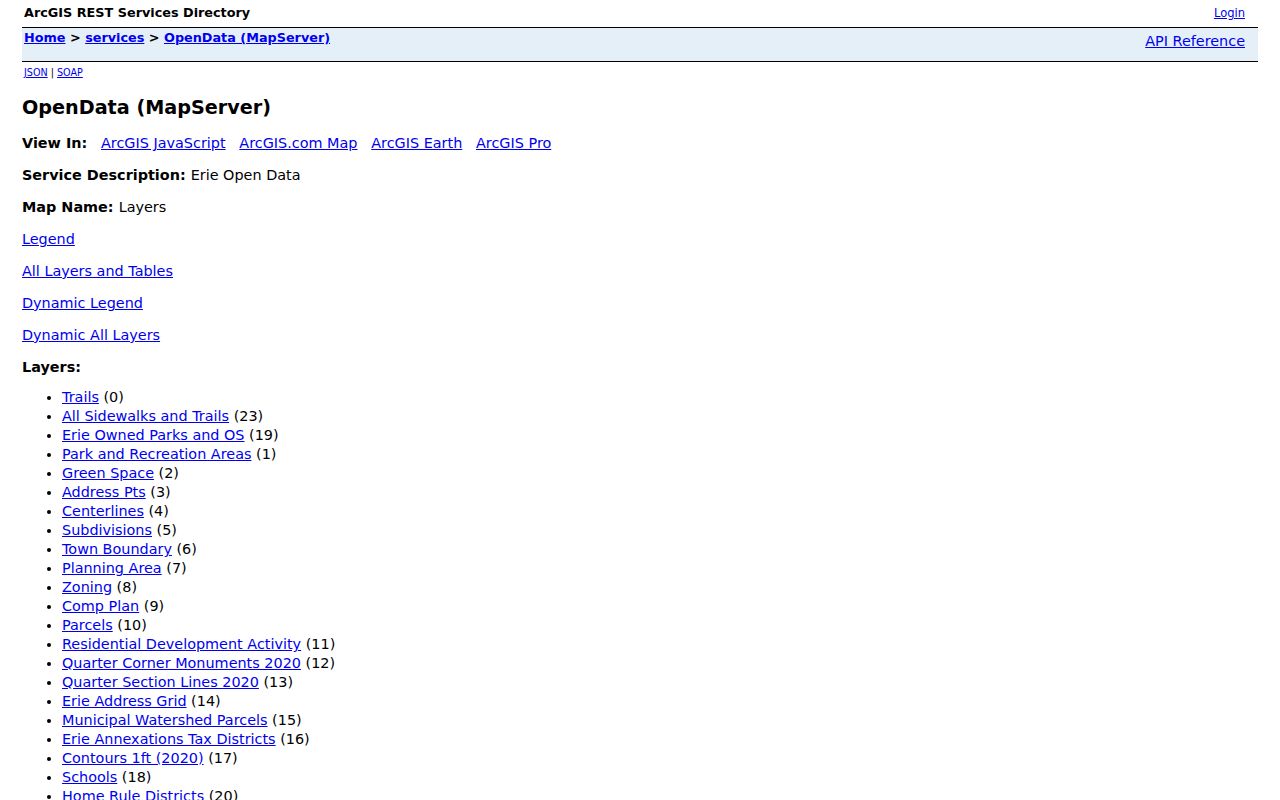
Treat the map as geography, not a household roster. Before moving to the assessor or recorder, save the parcel key, the county clue, the legal description, and your inspection date.
Check an Erie Voter Lookup Carefully
The Colorado Find My Voter Registration tool matches one known person. It asks for four fields. The ZIP is tied to the registration. The page advises trying a prior ZIP after a move. A match can confirm registration status and an election district. It cannot build a public street roster. It also cannot prove that everyone at an address is registered there.
Boulder County publishes monthly SCORE data along with request instructions. Weld County Clerk and Recorder serves as the local elections custodian for Weld-side records. Formal data requests can include residence and mailing fields, precincts, districts, and participation fields. Protected, confidential, and preregistered electors are excluded or withheld. Ballot choices stay secret.
| Lookup field | What to enter | Why it matters |
|---|---|---|
| First name | Name as registered | Preserve the spelling used by the record |
| Last name | Last name, or the name field for a one-name person | Try known spelling variants in a separate check |
| ZIP | Registration ZIP | Try the prior ZIP after a documented move |
| Birthday | MM/DD/YYYY | Helps separate same-name registrations |
A name may fail to appear in an Erie voter lookup. That is not the end of the story. Protected addresses, county-line confusion, and simple spelling differences all hide records. So do inactive files and recent moves. Treat the result as one clue inside the Erie residents directory. It is not a final ruling on where someone lives.
Current Erie Directory Sources
A missing result is rarely the whole story. Erie voter rolls shield certain addresses, and a name can drop out over a stray spelling difference, an inactive record, a county-line mix-up, or a recent move. Treat any lookup result as one clue within the broader Erie residents directory rather than a final verdict on where someone lives.
| Source | What it can show | Keeper | Access |
|---|---|---|---|
| Town parcel layer | Owner name, mailing and situs clues, legal and subdivision fields | Town of Erie GIS | Public map and query |
| Property portals | Owner, account, parcel, address, values, sales, or tax clues | Boulder and Weld assessors | Public county searches |
| Voter lookup or data file | Known-person registration, status, precinct, and permitted file fields | Colorado and county elections | Match tool or request |
| Recorder index | Grantor, grantee, instrument, date, legal description | Boulder or Weld Clerk and Recorder | Index, image, or office request |
| Town directories and cemetery | Business affiliation, contact route, burial or grave clue | Town of Erie | Public listings and search tool |
No single Erie residents directory folds all of these records into one file. Property rolls list owners who may be trusts, corporations, or absentee holders. A business entry can point to a work address. A cemetery result belongs to someone deceased. Historical city directory pages describe one year, nothing more. Match the evidence class to the question before trusting any single entry.
Read Erie Address Records Precisely
Erie address records usually carry two address families. The situs address pins down the parcel or building itself. The mailing address shows where tax mail goes. In the Town layer, `FULL_ADDRE`, street components, geometry, and `LOCCITY` sit beside `ADDRESS1`, `ADDRESS2`, `CITY`, `STATE`, `ZIPCODE`, and `CAREOF`. A care-of line may differ from the situs city. A mailing city may differ too. Either one tells you how correspondence travels. It does not prove the named owner lives there. When a street number changes, the legal description is the bridge. Keep subdivision, lot, block, parcel, and account values exact. Old deeds may cite a plat or a tract rather than a modern number. A ZIP code is a delivery label, not a municipal boundary. Hold these distinctions firmly. A resident lookup stays honest only under one condition. An ownership clue must never be mistaken for a claim about a household.
- Parcel
- A mapped tax or legal unit identified by an account or parcel key.
- Situs address
- The physical address used to locate the property, distinct from the tax mailing line.
- Legal description
- The recorded wording that identifies land by subdivision, lot, block, tract, or survey.
- Index
- A catalog of parties or instruments that may point to an image or certified copy.
Note: Preserve original spellings and address labels before adding a modern ZIP or city cross-reference.
Follow Erie Records Across the County Line
Boulder's public search leans on flexibility. It offers quick and advanced options, recorded-date ranges, index-only searching, and an OCR toggle. Watermarked images are free, while non-watermarked and certified copies cost money, according to the county. Weld's EagleWeb takes a different approach. It searches grantors, grantees, document types, reception numbers, dates, subdivisions, blocks, and lots. Its help page likens the index to a library card catalog. It also nudges users toward spelling variants. Neither index is a resident roster for Erie, even though Erie properties appear in both. A name in a deed is a start, not proof anyone lives there. The county record still anchors the truth. For a stronger ownership signal, the county offers a name-based Boulder property-fraud alert that watches newly recorded documents, though it warns about false matches from common surnames. That alert offers protection and an ownership clue. When a record truly matters, weigh the party name, legal description, instrument date, and image or certified copy against the parcel record.
| Official record | Best question | Primary limit |
|---|---|---|
| Assessor or parcel roll | Who is recorded as owner, and where is the parcel? | Does not list every occupant |
| Recorder index | Who joined a recorded transaction? | Index access is not the full instrument |
| Commercial people-finder category | What other public-record leads might exist? | May mix stale, paid, or same-name data |
For a defined personal, historical, or civic question, the primary county records remain the better source. A commercial compilation cannot correct the custodian's record and should not replace the records office process.
When Erie Needs a Records Request
Erie's town records hub gathers searchable ordinances, agendas, minutes, resolutions, policies, police records, municipal court records, contracts, and development documents. Material that is not indexed falls under the Colorado Open Records Act, or CORA. A strong CORA request names a date range, an address, a record type, and a department. Timing matters. A request arriving after 5 p.m. or on a closed day counts as received the next business day, per the Town's records guidance.
Building files can be deep. Expect permit cards, plot plans, improvement location certificates, and certificates of occupancy. Soils reports, receipts, and engineered documents may appear too. The Town allows up to three business days for most requests. Seven working days apply in some cases. Copyright can leave certain files view-only, and real staff, copy, map, or retrieval costs may apply. Erie Municipal Court handles criminal-justice records under the Colorado Criminal Justice Records Act. That route supplies no general criminal-history or driving-history report.
An eTRAKiT search may show a property has history but not the file needed. The Town building-record request page is the natural fallback. A narrow request works better than a sweep for everything about a person or property.
Note: CORA and CCJRA requests can produce a record, a redaction, a fee estimate, or a lawful refusal; each is an access outcome to document.
Erie Vital Records Need Eligibility
Colorado vital records are not a public, searchable residents directory. C.R.S. § 25-2-117 keeps vital-statistics records confidential. Certified copies demand a direct and tangible interest. Several custodians split the holdings: CDPHE, Boulder County Public Health, Weld County, county clerks, district courts, and the State Archives each keep different record types. An index clue from a historical source is simply not a certified record. It cannot stand in for a birth, death, marriage, civil-union, or divorce certificate.
Older research has its own rules. The State Archives opens birth records for research at 100 years. The inspected Boulder groups cover 1870-1909, 1880-1884, and 1892-1906. Official Colorado guidance treats death certificates as public after 75 years. Current certificates require proper ID and a relationship or qualifying interest. Fees apply, and the right county or state route matters too.
| Record | Where the Erie trail goes | Access boundary |
|---|---|---|
| Birth | CDPHE, Boulder, Weld, or Archives | Eligibility and ID for current copies; historical age rules |
| Death | CDPHE or county vital office, then cemetery and newspaper | Pre-public records need proof; older copies follow custodian rules |
| Marriage or civil union | County Clerk and Recorder, CDPHE, Archives, or FamilySearch | Custodian and record type control access |
| Divorce | District court file or CDPHE verification | Docket and decree access differs from protected attachments |
Erie Resident Reconnection Route
Family reconnection in Colorado runs through an official process, not through an open adoption file. CDPHE lays out adoption access under C.R.S. § 19-5-305. Eligible adult adoptees and certain other parties may apply for an original birth certificate. A court-appointed Colorado Confidential Intermediary can open a sealed file. The intermediary can also locate qualifying biological relatives. And the intermediary can broker contact between adults who both agree. Consent drives every step.
The Colorado Voluntary Adoption Registry works only when both sides register. It wants a notarized application, valid identification, proof of relationship, and a nonrefundable fee. A match then depends on the registry's consent and matching rules. This route serves family reconnection alone. It never converts adoption records into a public name directory.
Other personal searches have their own trails. An heir may need a probate docket plus a district-court or archive request. A former classmate may surface in yearbooks or school notices. The Erie Community Library may hold more. Regional newspapers can help too. Business ties belong in the Colorado Secretary of State or DORA record. Guessing at a private home from them helps no one.
Old Erie Directory Names Live in Regional Books
Erie was usually too small for its own phone book. The Denver Public Library Colorado Directories Index even uses Erie as its search example. Type `*Erie`, then browse the Longmont, Boulder, and Denver volumes. A family could live in Erie yet appear under a neighboring town or county label. The 1902 regional telephone subscribers directory covers Boulder, Broomfield, Eldora, Erie, Lafayette, Longmont, Louisville, and Lyons. Wallstreet and Ward round out its list.
For deeper digging, the Erie city directory collections cover the historical shelf in detail. A first pass should record the year and the original place label. It should also note the spelling, page, address, and call number. Then pair each hit with a census, deed, newspaper, cemetery, or court clue. A phone listing proves contemporaneous contact, nothing more. Ownership and full household membership need other evidence.
Erie Mount Pleasant Records Gap
Mount Pleasant Cemetery is both a goldmine and a trap for Erie people-record research. Town history dates the oldest headstone to 1869 and the next to 1871. Yet the first deeds naming "Erie Cemetery" come from 1901. The count runs to roughly 1,300 burials, with more than 300 unmarked graves. Almost nothing survives from before 1901 beyond the stones themselves.
Interment records stay spotty before the 1960s. Historic files hold about 200 burial transit permits. Over 100 lack any burial location, and only half could be matched to deeds. Cemetery software arrived in 2009. So an empty modern search does not erase a burial. Weigh the Town cemetery history against each headstone, deed, transit permit, newspaper notice, probate file, and death record. Treat every record as separate evidence.
Note: A cemetery database hit, a headstone, a deed, and an obituary each describe a different part of a deceased resident’s trail.
Finish an Erie Resident Search Lawfully
Public records serve honest purposes. Family history, civic research, and estate work fit. So does reconnecting with people who welcome the contact. They do not permit repeated unwanted outreach, threats, exposure, or intimidation. The stalking statute is C.R.S. § 18-3-602, and the harassment statute is C.R.S. § 18-9-111. The Address Confidentiality Program offers eligible survivors a substitute address with mail forwarding. Protected voter records may stay out of an ordinary lookup.
Before trusting any result, check the custodian’s date, fields, disclaimer, and correction route. Is a parcel, voter, vital, court, license, or directory record wrong? Contact the named office with the account, case, document, or record date. A responsible Erie residents directory search ends at a verified source boundary. Not a guess about someone absent from one database.